Adventure
The Catacombs of Saint Martens
by Eidolon Publishing
Loading full manuscript...
The Pitch
The Catacombs of Saint Martens is a dramatic reinterpretation of one of Dungeons & Dragons' most common set pieces: the evil necromancer's ritual. To emotionally engage players and create a player-driven, cinematic adventure, Catacombs takes the following approach:
Character-First Drama. Catacombs of Saint Martens is not a story about stopping an evil necromancer. Instead, Catacombs—which takes the position that war is merely politics by other means, and that combat is merely what happens when negotiations fail—asks three simple questions: what would drive a person to become an evil necromancer, what kinds of motivations would drive the players to stop him on an urgent timeline, and what supporting cast creates the richest potential for emergent narrative and drama?
Self-Balancing Combat. Catacombs creates tension not through a balanced adventuring day, but by juxtaposing swarms of low-threat fodder with intermittent threats and a solitary "near-peer" boss fight. Catacombs also provides DMs tools for easy live re-balancing, such as by empowering weak enemies with military-grade tactics and strategy (which the DM can downgrade at any time) and providing strong enemies with suboptimal theatrical "trap" options (which jack up the feeling of danger while lowering the real risk of a TPK).
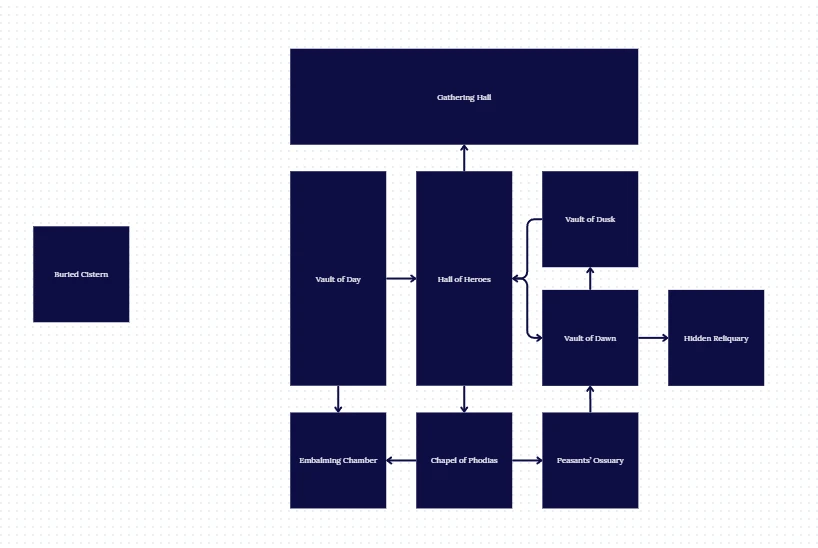
Open-Ended Locations. Catacombs of Saint Martens provides players with a "jacquaysed"—nonlinear and looping—dungeon, thereby maximizing player freedom to achieve their goals in any way possible. With that said, players aren't the only ones capable of circumnavigating the dungeon around them; if they're not careful, they might draw the attention of one or more clusters of enemy forces, who stand ready to crash down on them like a wave.
Emergent Storytelling. Catacombs has no "load-bearing pillars": players are free to attempt to persuade, deceive, and intimidate any intelligent character, no matter how villainous or antagonistic. (Indeed, NPCs who haven't already prepared an ambush may be more than willing to talk before hostilities erupt—especially if they think the players might have something they want.) However, attempts are no guarantee of success, and few enemies (especially those with real convictions) can be swayed by something as trite or patronizing as an inspiring speech or unenforceable promise.
The Players
Past. You're members, allies, or mercenaries of the Saint Martens city guard, the Lumontish military garrison, and/or Our Cathedral of Shining Dawns. When the call came to drive out a force of necromancers in the catacombs beneath the city, you answered—whether for loyalty, coin, obligation, or a simple desire to protect your home and neighbors. What followed was a three-day campaign down into the catacombs' deepest depths, filled with the screams of the dying, the clattering of old bones, and cries to rally and forge ever deeper.
Ultimately, it was only the capture and interrogation of three apprentice necromancers that revealed the true nature of the plot below the city: a powerful mage named Cyril Lambrecht, using the long-lost spellbook of infamous necromancer and thaumaturge Benoit Dumont, intended to complete and perform Dumont's most ambitious ritual: a rite that would consume the souls of all within its radius to fuel the birth of a new deity.
Present. When the adventure begins, you find yourselves at the base of a dusty stone staircase (leading back to the upper floors behind you).
Future. Your comrades, who bought your path forward in blood, hold the levels above your heads against waves of the walking dead. Now, alone and nearly ten stories underground, you're Saint Marten's one chance to uncover and halt the titanic ritual brewing beneath the city—and save your own souls from the ritual's all-consuming maw.
Dramatis Personae
The following characters appear in this adventure:
Cyril Lambrecht, a powerful necromancer conducting a ritual to consume thousands of souls in order to ascend to godhood.
Eveline Olivier, one of Cyril's two senior apprentices guarding the way to Cyril's ritual.
Sebastien Janvier, one of Cyril's two senior apprentices guarding the way to Cyril's ritual.
Guillaume Beaufort, the spirit of a serial killer inhabiting a stitched undead abomination created by Sebastien.
Roan Reynders, a long-dead imperial mage whose skeletal remains were animated by Eveline to join her undead forces.
Themiel, an angelic guardian sealed within a statue.
When the adventure begins:
The players are in a small hall immediately south of the Chapel of Phodias, at the base of a dusty stone staircase (which leads back to the upper floors behind them).
Eveline is guarding the Hall of Heroes with twelve skeleton soldiers, and twelve skeleton archers.
Sebastien is (ostensibly) monitoring the seal in the Vault of Dusk, accompanied by six reserve skeleton archers, while repeatedly assembling, animating, deanimating, and disassembling a skeleton cat inside.
Guillaume is (ostensibly) monitoring the seal in the Vault of Day, accompanied by twelve reserve skeleton soldiers, while systematically cracking, sucking, and savoring the marrow from each set of bones in the crypts within.
Roan is pretending to monitor the seal in the Vault of Dawn, accompanied by twelve reserve skeleton soldiers, while secretly studying the arcane runes on his skull binding him to Eveline's control.
Cyril is in the Gathering Hall with his zombie adult dragon, thirteen skeleton soldiers, twelve skeleton archers, and two zombie brutes, as well as three zombies beating a heartbeat rhythm on human-skin drums. (If one, two, or three zombies die, Cyril must use his Bonus Action, Reaction, and Action, accumulating, each round to prevent the ritual from collapsing. On initiative count 0 one round after the ritual collapses, each creature within a 30-foot radius must succeed on a DC 20 Constitution saving throw, taking 8d8 necrotic damage on a failure or half as much on a success.)
However, Eveline, Sebastien, Guillaume, and Roan freely move between rooms if prompted, alerted, or disturbed.
Pronounciation Guide
Saint Marten (mar-TEN)
Cyril Lambrecht (SEE-rill LAMM-brekt)
Eveline Olivier (ev-veh-LEEN oh-LIH-vee-yay)
Sebastien Janvier (seh-bas-TEE-yen ZHON-vee-yay)
Guillaume Beaufort (ghee-YOHM boh-FOR)
Roan Reynders (rone RAIN-durs)
Themiel (THEEM-ee-el).
Lumont (LOO-mont)
Aurele Paraflamel (oar-ELL para-fluh-MELL)
Arantaean (ah-RAN-tee-yen) Sea
Haeklanic (HAKE-lan-ick) Ocean
Monum (MOE-num)
Aslakis (az-LAH-kiss)
Phodias (foe-DAI-yus)
Maraedo (muh-RAY-doh)
Saint Clarine (claire-EEN)
Roudlaux (rood-LOH)
Vidunne (vih-DUNN)
Ghellaine (ghel-LAYN)
Berghidiene (bair-GID-ee-en)
Brives-le-Creuillon (breev-luh-CROY-yon)
Roudine (roo-DEEN) River
Brigaire (brig-AIR) River
The Stage
Saint Martens, Fortified City
Past. Founded at the confluence of the Roudine and Brigaire Rivers, at the western foot of the Berghidiene Mountains, Saint Martens holds one of three passes between the western humanoid empire of Lumont and the eastern draconic empire of Aslakis. When war broke out between Lumont and Aslakis several years ago, Saint Martens became a city under siege, its archpriests, imperial mages, and ballistae corps providing crucial defenses as Aslakian raids scorched the surrounding countryside and tested the city's ancient walls.
Present. Three days ago, a minor acolyte of the Church of Phodias—Lumont's patron deity of kings, justice, and the Sun—found something curious in an old cellar of Our Cathedral of Shining Dawns: evidence of recent human habitation. Further investigation revealed that the city's old catacombs, which sprawled beneath the Old City and Upper City, had become infested with undead—and a small army of necromancers. The Church and city guard rallied an assault force, and a subterranean invasion began.
Future. Reports from imperial haruspices and Church diviners have located a growing emanation of powerful necromantic magic coming from the Tomb of Divine Rays, the resting place of Saint Marten's most ancient and celebrated heroes. Though the cause is impossible to deduce from above, old maps have identified a small leyline flowing directly beneath the Tomb—one whose power, if properly channeled, could fuel a powerful necromantic ritual.
Lumont, Holy Imperium
Past. Founded nearly five hundred years ago by His Imperial Majesty Aurele I Paraflamel, the kingdom of Lumont spent the next three hundred years becoming an empire, one conquest or annexation at a time. Now covering much of the western half of the Hespran continent and controlling passage from the Arantaean Sea into the Haeklanic Ocean, the Lumont Empire regards itself as heir to the legacy of Monum—the ancient empire that once encircled the Arantaean like a serpent.
Just over a century ago, Lumont's border first abutted the expanding empire of Aslakis—a draconic nation sprawling from the bones of East Monum to the southwestern reaches of Anolia, along the eastern edge of the Arantaean. In the decades since, as Aslakis consolidated its strength after an internal civil war, the two empires have warily tested each other's defenses—Lumont hungering for Aslakis's Anolian trade routes, and Aslakis envying Lumont's access to the Haeklanic Ocean.
Eight years ago, shortly after the twenty-six-year-old Emperor Aurele IV took the throne from his late father (over the corpses of a half-dozen siblings and cousins), a young gold dragon by the name of Parlakanat—the second son of a minor Aslakian governor, and a member of Aslakis's highest draconic caste—flew across the border, then incinerated and plundered the small hinterland village of Saint Clarine.
When news of Saint Clarine's fate reached Lumont's capital, Emperor Aurele—determined to seal his right to his father's legacy and crush any skeptics of his strength—commanded General Marcel Favrus to dispatch an elite unit of the Knights of the Golden Order to capture the dragon and bring it alive to the capital to face justice. Following his transport to Lumont's capital, the emperor had him muzzled and crucified in the city square before the city's populace.
With news of Parlakanat's desecration ringing through the skies, Aslakis dispatched a platoon of draconic warriors to incinerate the province of Roudloux that once held Saint Clarine, village by village, and town by town, and ending with the provincial seat. It took four days for the dragons to reduce the entire province to ash. Lumont declared war less than a week later.
Present. Lumont's war effort is not going well. Although General Favrus has vowed that the "overgrown lizards" will be brought to hell by the winter solstice, Aslakis's forces have made steady inroads into Lumontish territory, though their progress has stalled in recent years. Today, Saint Marten and its control of the Berghidiene Mountains form one of the keystones ensuring Lumont's defense. If the city were to fall, Aslakis's offensive would be empowered anew, opening a clear line to Lumont's heartlands and capital.
The Sets
Chapel of Phodias
History. This chapel is one of the oldest sites of Phoedesian worship in Lumont, and the place where the dead, their mourners, and the clergy prayed and were sanctified before proceeding deeper into the Tomb of Divine Rays.
Features. The air here is frigid and dust-choked. Bas-reliefs of the shining sun, proud angels, fierce warriors, and mighty kings line the walls, framing a mighty statue of Phodias: the King of Kings, clad in sweeping flame-kissed robes, bearing a crown of radiating sunrays, and wielding a sword of fire.
In the northwestern corner, atop a small, dry, empty offering fountain, stands a statue of a handsome female angel clad in flowing robes, with long tresses and a spear held point-down in one elegant hand.
Thick, rotted oaken doors reinforced with bands of rusted iron lead east (to the Peasants' Ossuary) and west (to the Embalming Chamber), and tall golden doors carved with the image of a rising sun lead north (to the Hall of Heroes).
Secrets.
Themiel. The statue houses Themiel's spirit, who telepathically addresses any she feels can aid her. If the players destroy the arcane seals in the Vaults of Day, Dusk, and Dawn, she can turn the entirety of the Tomb into consecrated ground (forcing undead to make all saving throws with disadvantage and preventing additional undead from entering or being created within the Tomb) and unlock the hidden door to the Hidden Reliquary—but only if the players swear their sacred vow to bring her the severed heads of the necromancer (Cyril) and his servants.
Cistern Entrance. A three-foot-wide iron grate in a low channel encircling Themiel's fountain covers a stone shaft, which plunges five feet through mortared stone before emerging twenty feet above the floor of the Buried Cistern below.
The Rat. An undead rat (one of Sebastien's creations) watches from a small crack in the eastern wall. Upon sighting intruders, it scurries into the Peasants' Ossuary, squeezes through a crack in the northern wall to enter the Vault of Dawn, and enters the Hall of Heroes, where its presence alerts Sebastien and Eveline to intruders. (Once alerted, the two necromancers take cover behind the doors leading to the Vault of Day and the Vault of Dusk, but hold their forces and fire until the players open the doors leading from the Chapel to the Hall of Heroes.)
Embalming Chamber
Peasants' Ossuary
History. This chamber, once an ordinary burial chamber, was retrofitted as an ossuary—a resting place for hundreds of separate remains—when increasingly limited space in the Vaults of Day, Dusk, and Dawn required that the bones of commonfolk be exhumed and relocated to make room for those of nobles, warriors, and clergy.
Features. The air here is cold and dank, with a faint scent of mold and mildew. Three piles of bones fill the space here: a tall pile of large bones (such as femurs, ribs, hip bones) in the northwest; a smaller pile of small bones (such as finger bones, vertebrae, and foot bones) in the southwest; and a long pile of skulls along the eastern wall.
A six-foot-tall, three-foot-wide, one-foot-deep, one-and-a-half-ton stone slab fills the northern doorway that once led to the Vault of Dawn, carved with the insignia of a rising sun and sealed with mortar and plaster.
A two-foot-wide circular hole in the center of the floor holds the rotted stubs of a wooden grate.
Secrets.
The Crack. A crack in the slab's bottom left corner leads to the Vault of Dawn to the north.
Cistern Entrance. The hole plunges ten feet through mortared stone—five feet vertically, then seven feet diagonally—before emerging through the southeastern wall of the Buried Cistern below, twenty feet above the cistern's floor.